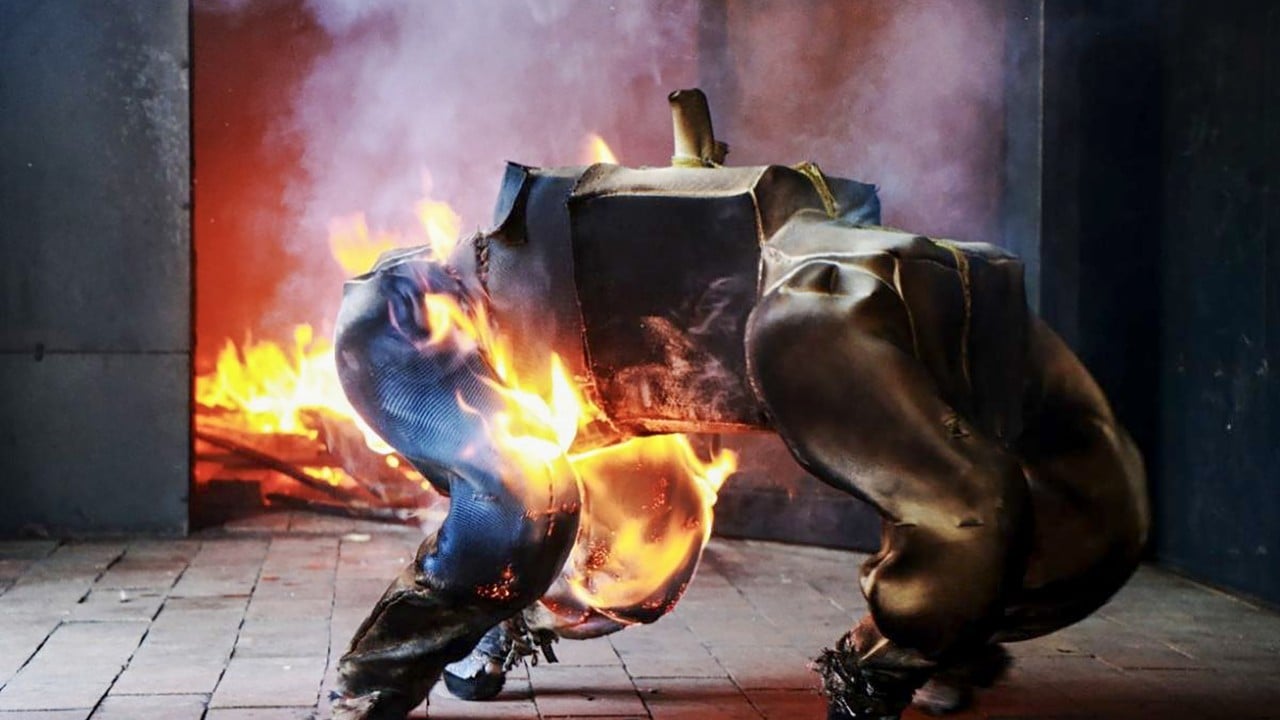
A fire-resistant robotic dog developed in China was tested in an open-flame environment reaching up to 1,000 degrees Celsius in Suzhou, Jiangsu province. The Harbin Institute of Technology Suzhou Research Institute said the robot, fitted with a specialised heat-protection suit, was sent into the fire area and continued reconnaissance tasks for 10 minutes.
The robot was covered with an outer protective layer made from a specialised composite fire-resistant material inspired by space technology. According to the institute, the layer helped preserve the robot’s mobility in high-temperature open flames and protected critical components from damage. Following the test, the robot’s gait was reported to remain stable, while its battery compartment measured about 43 degrees Celsius and its joint motors about 70 degrees Celsius.
The test was conducted on 25 November 2026 at the Fengyang Road Special Mission Station of the Suzhou Fire Rescue Unit. The fire environment was created using straw, charcoal and petrol. For 10 minutes, the robotic dog carried out environmental reconnaissance, positioning and information transmission tasks. The institute described it as a “fire reconnaissance robot dog capable of withstanding a high temperature of 1,000 degrees”.
The project involved the autonomous unmanned systems and intelligent equipment team at the Harbin Institute of Technology Suzhou Research Institute and Sichuan Longjia Aerospace Materials Technology. The institute said conventional quadruped robots face limitations in thermal protection, sensing and communications continuity at fire scenes. It said the new system was designed for pre-fire reconnaissance, inspection and information gathering in hazardous areas.
Fire scenes can expose crews to high temperatures, dense smoke, poor visibility, toxic gases and the risk of structural collapse. The research team said the technology could provide data on the location of a fire, the possible location of people trapped inside and surrounding risks before firefighters approach hot spots. It also said the technology could be considered for military applications.
No timetable was provided for operational deployment of the system. There is also no verified additional information on mass-production costs, a schedule for widespread field use or official procurement plans.