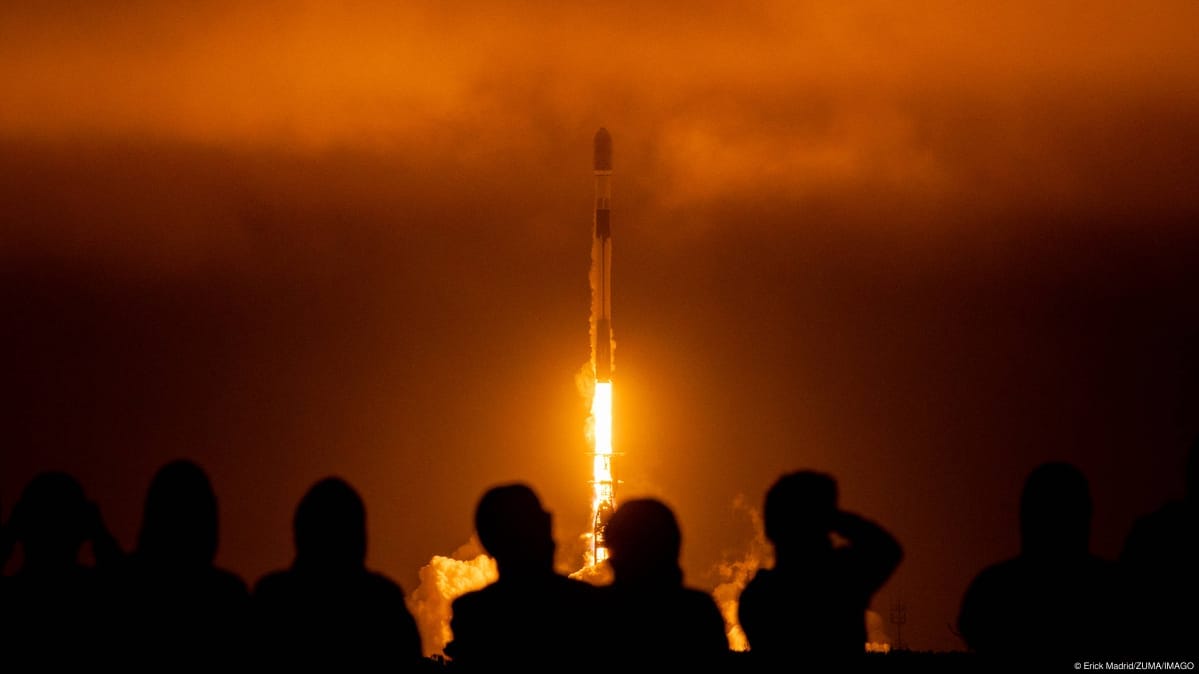
The US Federal Communications Commission has authorized Elon Musk’s SpaceX to launch up to one million satellites for a plan to build data centers in space. A document published on the FCC’s website says the authorization will remain valid through 2040. Musk aims to send the first satellites into space at the end of 2027.
FCC Chair Brendan Carr said on Wednesday that America was bringing the world into the “age of superintelligence.” Carr said space-based data centers were “indispensable” to the “superintelligence” term used by US President Donald Trump to describe artificial intelligence.
Under SpaceX’s Starmind project, the satellites are intended to operate close to one another in low Earth orbit to support reliable data transmission between them. Data would be sent back to Earth through satellites already in space for SpaceX’s Starlink internet service. US AI chip maker Nvidia is expected to supply latest-generation processors specially designed for use in space, while other companies plan to transmit data to Earth by laser.
The American Astronomical Society said it was “disappointed and appalled” by the FCC decision. It said larger, brighter and more numerous satellites could remain extremely bright objects in the night sky for long periods, “significantly limiting” the ability of both astronomers and the public to observe and explore it. Jan Hasselman of the environmental organization Earthjustice also criticized the decision, saying a major increase in satellite numbers has direct effects on people’s lives and the future of the planet.
Musk combined AI company xAI and SpaceX in February to pursue the construction of data centers in space. In an August statement, he said the first satellites were planned for launch in the final quarter of 2027, with the number of launches to increase in 2028. Musk argued that AI’s growing energy needs “cannot be met on Earth without harming people and the environment.”
A key potential advantage of space-based data centers is uninterrupted access to solar energy. According to Google’s calculations, solar panels in an appropriate sun-synchronous orbit can generate up to eight times more energy than they can on Earth. Technical challenges remain, however: processors must withstand high radiation levels, while extreme temperatures, space debris and micrometeoroids can cause damage. Google and Blue Origin, the space company founded by Jeff Bezos, are also working on similar projects.