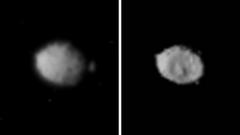
The first images from the European Space Agency’s Hera spacecraft show that NASA’s deliberate 2022 DART impact created a stadium-sized crater on the asteroid Dimorphos. Dimorphos posed no threat to Earth. The experiment was designed to test whether an asteroid’s orbit could be altered as a planetary-defence measure.
Dr Sabina Raducan, a member of Hera’s science team, said the crater was almost as large as the celestial body itself and described the result as highly impressive. She said it was difficult to put into words the excitement of finally seeing what had happened and added that, as a crater enthusiast, she found it very beautiful.
DART struck Dimorphos at 22,000 km/h. The impact generated a debris trail about 10,000 km long, detected by telescopes on Earth and in space. Dimorphos, about 150 metres wide, was selected because it is the smaller member of an asteroid pair, orbiting Didymos, which is about 730 metres wide. Before the collision, Dimorphos completed an orbit of Didymos in 11 hours and 55 minutes; after the impact, that period was shortened by about 33 minutes.
Hera will study Dimorphos and Didymos over the next six months and send further images from closer range and at higher resolution. One key task is to measure Dimorphos’s mass to determine how effective the spacecraft’s impulse was. Professor Simon Green of the Hera science team said the findings could help predict the result of striking another asteroid. The source notes that an asteroid more than one kilometre in diameter could cause global devastation, while medium-sized asteroids comparable to Dimorphos could destroy a city.