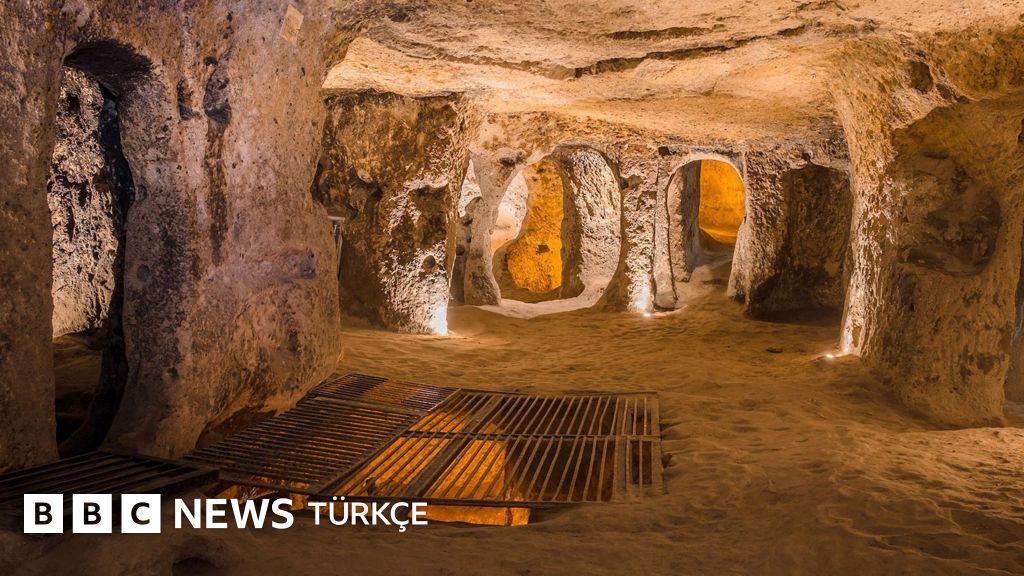
Beneath Cappadocia’s rock formations, shaped by wind and rain over millions of years, lies the ancient underground city of Derinkuyu. The network of tunnels and rooms was used as protection from Arab armies that raided the region. Derinkuyu is reported to have served this purpose between the middle of the 7th century and the beginning of the 11th century.
Temperatures inside Derinkuyu remain at about 15-17°C throughout the year. That creates a comparatively stable environment when conditions above ground include a severe snowstorm or an intense heatwave. Climate researchers and urban planners are considering whether the features of Cappadocia’s underground architecture can help inform the design of shelters suited to changing climate conditions.
Ali Yamaç, a founding member of the Obruk Cave Research Group, has spent the past 15 years studying and documenting caves and underground structures in Cappadocia with the group. The work is being carried out in cooperation with the Kayseri municipality. “Whether natural or man-made, temperatures in all caves reflect an average of above-ground temperatures over the course of the year,” Yamaç says. He describes cooler conditions in summer and warmer conditions in winter as a major advantage.
By some estimates, Türkiye has already warmed by 2.1°C compared with the pre-industrial period. Rising temperatures are said to be intensifying heatwaves, making droughts more frequent and changing rainfall patterns, increasing concerns about flood risk. A recent modelling study also found that deaths linked to extreme heat in Istanbul are expected to rise tenfold by the end of this century.
Derinkuyu stands out among the region’s extensive underground spaces because of its scale. Some sources describe it as having six to 12 levels, while others say it descends as far as 18 levels and reaches a depth of 85 metres. Spread across an area of 2.5 kilometres, it could accommodate 20,000 people and had 53 water wells and ventilation shafts. Its tunnels are not used as climate shelters today, but other underground spaces may be well suited to that purpose.
Francesco La Vigna, a researcher at the Italian Institute for Environmental Protection and Research (ISPRA) and chair of the EuroGeoSurveys (EGS) Urban Geology Expert Group, says cities have become accustomed to expanding vertically above ground. He argues that underground space must also be considered and that doing so requires a cultural shift. The case of Derinkuyu is drawing attention to the potential of underground spaces as climate conditions change.