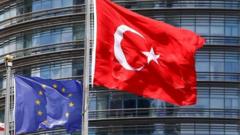
The growing prominence of strategic alignment in the European Union’s enlargement assessments has brought foreign policy into sharper focus in Turkey’s membership process. The European Commission’s 2025 report on Turkey said Ankara had not shown a willingness to increase alignment with the EU’s common foreign and security policy. It said that position was at odds with Turkey’s stated objective of joining the EU.
For the EU, strategic alignment goes beyond technical alignment with legislation. The bloc expects candidate countries to move closer to its positions in foreign policy statements, sanctions regimes, security priorities and responses to crises. The European Commission’s 2025 Enlargement Policy Communication stressed that candidates should give priority to improving alignment with the common foreign and security policy and refrain from actions and statements that run counter to EU foreign policy positions.
For Turkey, those expectations intersect with several sensitive foreign policy issues. European Parliament assessments underline the country’s strategic importance as a NATO member while maintaining that cooperation with the EU should advance in a gradual, proportionate and reversible way. The same assessments criticise Turkey’s low level of alignment with the common foreign and security policy, its relations with Russia and Iran, its BRICS+ application, its failure to fully align with sanctions against Russia, and its refusal to designate Hamas as a terrorist organisation.
Against that backdrop, strategic alignment could become less a new formal negotiating chapter than a measure that tightens existing political conditionality for Turkey. EU institutions want to continue cooperation with Ankara on migration, energy, trade, the defence industry and regional security. But where full membership is concerned, the expectation that Turkey’s foreign policy choices move closer to the Union’s approach is being stated more explicitly.
The EU’s new enlargement approach highlights gradual access for candidates to parts of the Single Market, earlier participation in programmes and closer cooperation in strategic areas. Yet these interim integration models are also assessed in connection with reform performance, democratic standards and foreign policy alignment. Progress in practical areas including the customs union, industrial cooperation, visa facilitation, research programmes and security dialogue may therefore be affected by those conditions.
Turkey presents its multi-dimensional foreign policy in terms of mediation in regional crises, energy security, defence capacity and strategic autonomy. EU institutions, particularly since Russia’s war against Ukraine, have sought clearer alignment from candidate countries on foreign policy and sanctions regimes. Strategic alignment has not been defined as a standalone formal obstacle, but its increasing emphasis in EU documents signals the growing importance of political conditions in the membership process.