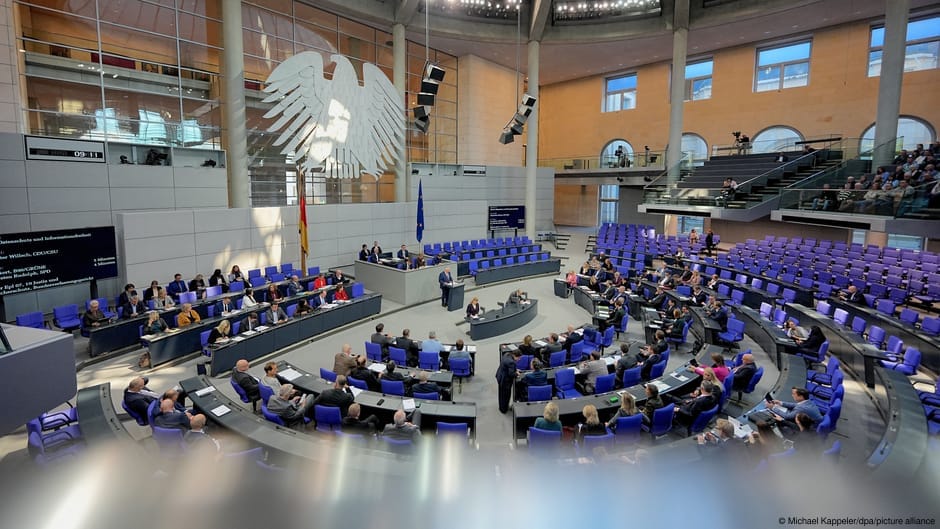
Germany’s federal parliament, the Bundestag, has approved the 2027 federal budget following lengthy negotiations. The decision authorizes the federal government to spend about €556 billion through the core budget next year. That represents an increase of roughly €31 billion compared with 2026. The measure passed with 317 votes in favour and 260 against.
Including debt-financed special funds for infrastructure and climate-neutrality investment, as well as for the German armed forces, the Bundeswehr, Germany’s total new borrowing in 2027 is expected to exceed €210 billion. Finance Minister Lars Klingbeil described the new borrowing as “necessary but regrettable”. He said the special fund approved by the CDU/CSU and SPD coalition was an important investment in children’s future, while warning that citizens would face greater financial challenges in 2028.
The regular budget allocates €109.7 billion to defence. Defence Minister Boris Pistorius will also be able to use an additional €29.9 billion from the special fund created for the armed forces. Total defence spending in 2027 is therefore projected to reach €139.6 billion. In 2026, Germany allocated a combined €108.2 billion, comprising €82.7 billion from the defence budget and €25.5 billion from the special fund. The increase is intended to support military modernisation and equipment needs.
The largest budget item is the Ministry of Labour and Social Affairs, which receives more than €200 billion. Most of that funding is to be used for pension payments and basic income support in old age. The Bundestag also adopted a budget-related law containing additional tax measures. Under the law, electricity tax will be reduced by 2.3 cents per kilowatt-hour from the start of 2027. From 2028, sugary drinks will face a tax of 25 to 35 cents per litre depending on sugar content, while taxes on various alcoholic beverages will rise.
The law also enables the transfer of €2.7 billion from the Climate and Transformation Fund, or KTF, to the core budget. A previously planned €1 billion reduction in the federal contribution to statutory pension insurance was increased by a further €3 billion. Klingbeil said there was currently a €25 billion budget gap, which could rise to €30 billion if the electricity-tax reduction continues beyond 2027. Opposition parties criticised both the budget’s substance and the preparation process, citing numerous last-minute changes.