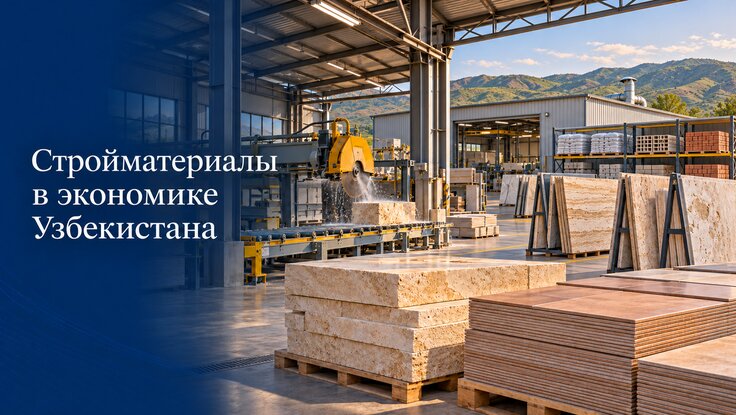
Uzbekistan has invested $12 billion in building-materials production over the past decade and commissioned more than 5,000 modern enterprises. The sector’s output stood at 7 trillion soums in 2016, while exports totalled $75 million. By the end of 2026, output and exports are expected to reach 65 trillion soums and $1.5 billion respectively. If that forecast is met, output at current prices will be about 9.3 times the 2016 level and exports in dollar terms will be 20 times higher.
Installed capacity is already sufficient to meet domestic demand for 161 types of building materials, including ceramic tiles, basalt coverings, construction glass and aerated-concrete blocks. Annual imports nevertheless stand at $780 million. Large-format tiles alone account for $25 million a year, while imports of eight types of finished goods, including paints and varnishes, wallpaper and energy-efficient glass, have reached $280 million. The meeting heard that buyers focus on format, design, quality and brand reputation, meaning that simply expanding familiar product lines would not by itself displace imported products.
Construction is beginning on a $30 million paint-and-varnish plant in Zangiata district in partnership with Turkish company Betek. Preliminary estimates put building-material requirements for the nuclear power plant in Jizzakh region at $2.2 billion. A 200-hectare special industrial zone with a separate tax and customs regime is planned in the Egizbulok mahalla, where enterprises are expected to master production of 70 new types of goods for the plant. From 2027, $200 million is earmarked for high-value-added new-material projects at 6% annual interest, with a two-year grace period.
At the 47-hectare Oltin bel complex in Kumushkan, local enterprises supplied 95% of the products used in construction and fit-out. The site includes four hotels, two restaurants, 51 chalets, a water park and an amphitheatre; it can serve 6,000 guests at one time and is designed to create up to 600 jobs. Local procurement was assessed to have reduced the project’s cost by 20%. The International Tourism Academy courses at the complex have already trained 300 specialists.
Uzbekistan had received 11.6 million foreign tourists from the beginning of 2026 to the time of the meeting, with more than 15 million expected for the full year. Over the past two years, the average stay of visitors from distant foreign countries rose from 6.5 to 8 days, while their average spending per trip increased by 21%. The share of tourists with high purchasing power grew from 14% to 21%. A tourism development strategy being prepared targets 20 million foreign tourists, an increase in the sector’s share of the economy from the current 3.5% to 7%, and $10 billion in tourism-services exports.
From 2027, locally made materials are planned to receive priority in budget-funded construction. A separate marketplace will be opened for their producers on the public procurement portal, with the potential size of this market estimated at 15 trillion to 20 trillion soums a year. Three testing laboratories are also planned in Tashkent, Fergana and Samarkand to compare material specifications and identify products that may pose a risk to consumers. Their locations are to be determined within a month, and the laboratories are scheduled to begin operating in 2027.