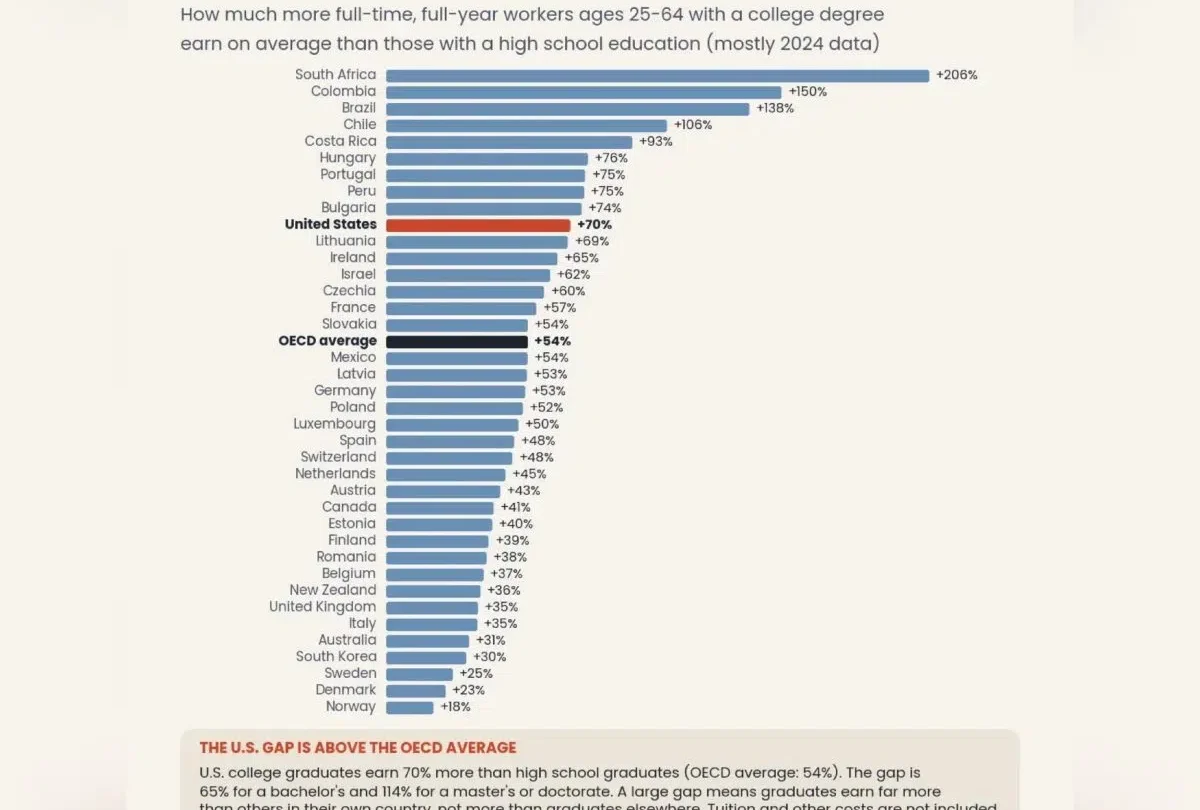
Workers with higher education earn more than employees with upper secondary education in many countries, but the size of that advantage varies considerably. Across 35 OECD countries for which data were available, workers with higher education earned 54% more on average than those with upper secondary education.
The comparison covers workers aged 25 to 64 in 38 countries who worked full time throughout the year. The higher education group includes people with bachelor’s, master’s and doctoral degrees. Under the OECD classification, short-cycle tertiary education programmes are also included in that category.
The infographic, prepared by Babak Sheikh and presented on the Voronoi platform, uses OECD data. South Africa recorded the largest difference among the countries shown, with the average pay of workers with higher education standing 205.8% above that of the comparison group.
A 205.8% difference indicates pay at about 3.06 times the level of the comparison group, rather than simply twice as high. In Colombia, Brazil and Chile, the average income of workers with higher education was also more than double that of workers with upper secondary education. The gap was about 70% in the United States, approached a twofold level in Costa Rica, and stood at 17% in Norway.